How to Tire Out a Puppy Without Over-Walking Their Joints
You can tire out a puppy without a single extra step on pavement — sniffing, problem-solving, and controlled play do the work that long walks shouldn't.
On this page
The first time I met a nine-month-old Labrador named Otis, his owners were exhausted before he was. They’d been walking him three miles a day since he was twelve weeks old, trying to keep up with a dog who never seemed to run out of steam. By the time I examined him, he had a subtle hitch in his right hind leg after rest — nothing dramatic, but enough that his family had started to worry. We talked about what “tired” actually means for a growing dog, and I told them what I tell most families in this position: the fatigue they were chasing on pavement was available somewhere much safer.
Start with what a puppy’s joints are actually doing
A puppy’s long bones grow from soft, cartilage-rich growth plates near each joint, and those plates don’t finish hardening into solid bone until somewhere between roughly six and eighteen months of age, depending on the dog’s eventual adult size. Small breeds tend to close earlier; giant breeds take the longest. Until that closure happens, the growth plate is often the weakest point in the leg — weaker than the tendons and ligaments around it — so repetitive impact and forced, long-distance walking fall on the part of the leg least able to absorb it. VCA Hospitals describes exactly this vulnerability, and notes that the damage from overuse isn’t always dramatic in the moment — it can show up later as uneven growth or joint pain that follows a dog into adulthood.
This is the tension I sit with in almost every puppy consult: owners are not wrong that their dog has energy to burn. They’re wrong about where that energy needs to go.
What the “tire them out” instinct gets right — and where it misfires
Most owners default to walking because it’s simple and visible — you can see the miles add up. But structured, forced exercise (leash walking, jogging alongside a bike, repetitive fetch on hard ground) is the category vets ask families to ration in young dogs. A commonly cited rule of thumb caps structured exercise at around five minutes per month of age, twice a day, until a puppy is closer to skeletal maturity — so a four-month-old puppy tops out around twenty minutes of continuous walking per session, not an hour at the dog park. Free, self-paced movement — sniffing around a yard, wandering at their own speed — isn’t held to that same limit, because the puppy is controlling their own impact and pace.
Build the day around the brain, not the legs
In my experience, the fastest route to a genuinely settled puppy is mental fatigue, not physical mileage. Dogs process the world largely through scent, and asking a puppy to search, sort, or problem-solve for their food taps a different kind of exhaustion than a walk does. AKC points to short training sessions, puzzle feeders, and scent games as ways to wear a puppy out that don’t load the skeleton the way repetitive walking does — and in my own caseload, ten or fifteen focused minutes of a snuffle mat or a “find it” game routinely leaves a puppy sleepier than a leash walk twice that length.
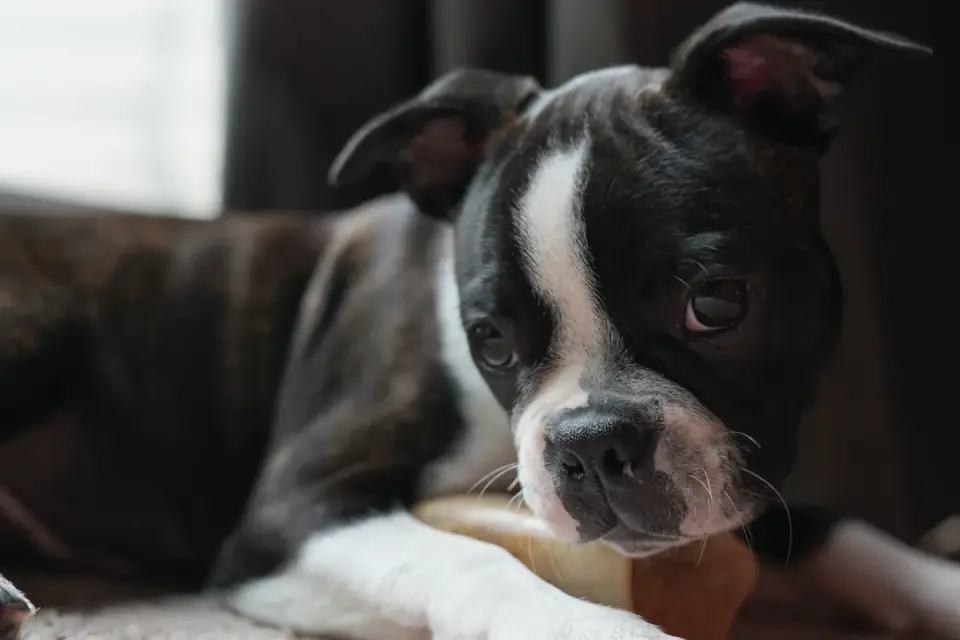
Here’s what I actually build into a plan for a young, high-energy puppy:
- Snuffle mats and scatter feeding. Toss part of a meal into grass or a mat instead of a bowl. Low joint load, high mental cost.
- Short, structured training reps. Five to ten minutes of sit-stay-recall work, two or three times a day, asks for focus rather than distance.
- Puzzle feeders and food-dispensing toys. These slow a puppy down and force problem-solving, which is genuinely draining for a young brain.
- Controlled tug and flirt-pole play, in moderation. Short bursts on soft ground, with breaks — not endless repetition on concrete.
- Supervised social play with a known, appropriately sized playmate. Self-regulated wrestling on grass lets a puppy control their own impact in a way forced walking doesn’t.
- Novel environments in small doses. A new room, a new yard corner, a cardboard box to investigate — novelty itself is tiring.
One line I say to almost every family with a bouncing, six-month-old dog: a tired puppy is not always a walked puppy, and a walked puppy is not always a rested one.
Where I land, and the counterargument I take seriously
The strongest pushback I hear is that puppies — especially working and sporting breeds — genuinely need physical outlets, and that mental games alone can leave a highly driven young dog under-exercised and reactive. That’s fair, and I don’t dispute it. My answer isn’t “no walking.” It’s proportion: keep structured walking short and let free-roaming, self-paced movement and mental work carry the bulk of the day’s fatigue until the joints have caught up. A puppy allowed to sniff, wander, and set their own pace in a securely fenced yard is doing real physical work without the repetitive impact of a forced mile on a leash. I’d rather a family under-walk and over-enrich during this window than the reverse — the downside of too much unstructured sniffing is boredom; the downside of too much forced walking can be a joint problem that outlasts puppyhood.
This is also where I think a lot of well-meaning advice online gets it backwards — it treats exercise as a volume problem when, for a growing dog, it’s a load-management problem.
A day that actually tires a growing dog out
For a four- to seven-month-old puppy, I generally sketch out something like: a short structured walk capped near the five-minutes-per-month guideline, a ten-minute scatter-feed or snuffle-mat session with part of a meal, a couple of five-minute training reps spread through the day, fifteen to twenty minutes of supervised, self-paced play with a familiar dog or family member, and a puzzle feeder for the last meal of the day. None of that requires the joints to absorb repeated impact, and in my experience it produces a puppy who sleeps hard that evening — which, more than any mileage count, is the outcome families are actually chasing.
I’ve also watched puppies who were joint-injured young grow into adult dogs managed for early arthritis — which is part of why, if you’re already navigating a dog with joint changes, it’s worth understanding what the research actually supports for joint care; our piece on hyaluronic acid for dog joints walks through the evidence plainly. And because a tired, well-regulated puppy also tends to be a puppy with fewer frustration-biting episodes, it’s worth pairing this with our guide on stopping puppy biting and mouthing if that’s part of what’s driving the exhaustion campaign in your house.
The forward-looking piece
Growth plates close. The window where this matters most — roughly the first year of a dog’s life — is short relative to the years of mobility that follow it. Families who prioritize low-impact, brain-forward fatigue during that window aren’t sacrificing anything permanent; they’re buying time for the skeleton to finish building itself properly. I’d rather see a puppy a little under-walked at five months than see that same dog, at seven years old, dealing with a hip or elbow that never had the chance to develop right. That’s not a dramatic claim — it’s just how cartilage becomes bone, and why patience with the leash pays off later.
Frequently asked questions
At what age are a puppy's growth plates fully closed?
It varies by size, but most dogs reach full growth-plate closure somewhere between six and eighteen months, with small breeds finishing earlier and giant breeds taking the longest, according to [VCA Hospitals](https://vcahospitals.com/pediatric/puppy/health-wellness/puppy-exercise).
Is sniffing around the yard okay even if walks are limited?
Yes. Free, self-paced movement like sniffing and wandering lets a puppy control their own impact and pace, which is different from forced, repetitive walking on a leash.
How long should mental enrichment sessions be for a young puppy?
Short sessions are usually enough — ten to fifteen minutes of focused scent work or puzzle-feeding can be as tiring as a much longer walk, per [AKC](https://www.akc.org/expert-advice/health/puppies-mental-physical-exercise/).