How to Stop Puppy Biting and Mouthing (Without Losing the Bond)
Medically reviewed by Jessica Ennis, DVM, CVA — For general education — not a substitute for veterinary care.
To stop puppy biting, teach bite inhibition first and manage arousal, because the mouth is how puppies explore.
On this page
It’s 7 p.m. on a Tuesday, and a nine-week-old Labrador puppy is doing what nine-week-old Labrador puppies do best: launching at ankles, grabbing sleeves, and clamping down on a hand that was only trying to scratch her ears. The owner is frustrated. There’s a thin red line on his forearm from a puppy tooth that caught skin during a game that started fine and escalated in about ninety seconds. He’s already looked up three different training methods online, and none of them agree with each other.
I’ve sat across from that exact scenario more times than I can count in exam rooms, and the puppy is almost never “aggressive.” She’s overtired, overstimulated, and about four hours past her last nap. That combination — a developing nervous system, a mouth that’s still the primary way she investigates the world, and an owner who’s inadvertently kept the play going too long — is the real story behind most biting complaints I see in puppies under six months old.
Why puppies bite and mouth in the first place
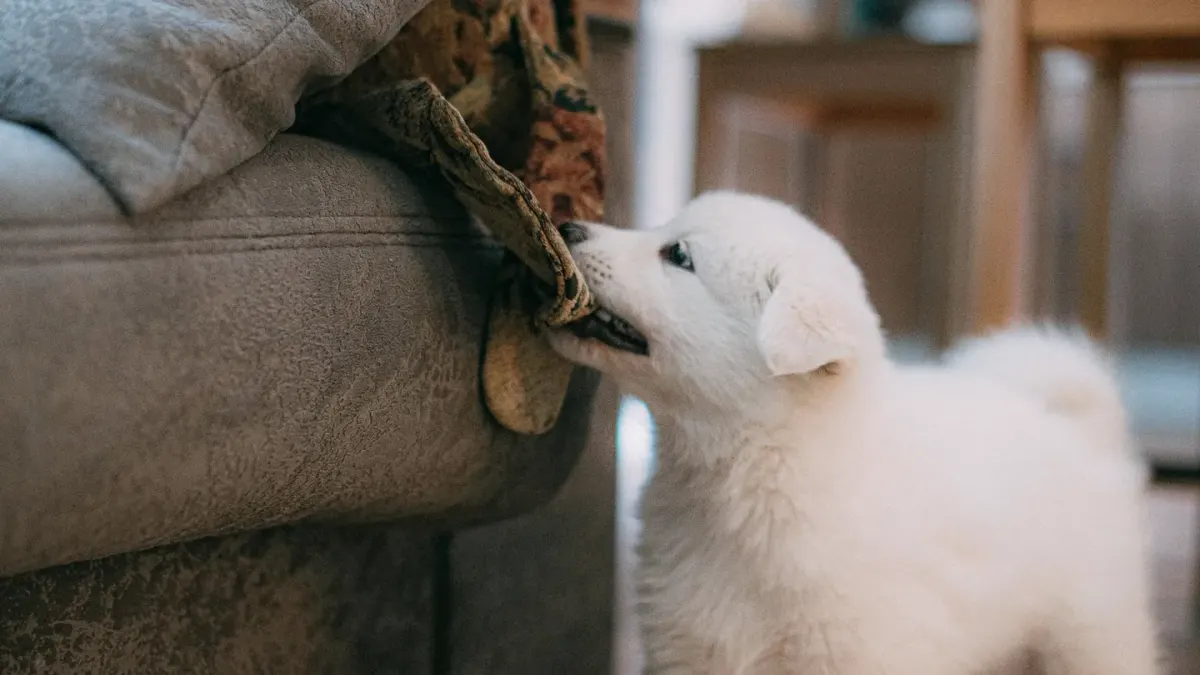
Puppies explore with their mouths the way toddlers explore with their hands. Mouthing during play, teething, and normal social interaction with people is developmentally expected, not a behavior problem to eliminate outright. What you’re actually managing is the pressure and frequency of that mouthing — teaching a young dog that human skin isn’t a chew toy, without extinguishing the exploratory drive itself.
Littermates teach bite inhibition through feedback: a yelp, a pause in play, withdrawal. Once a puppy leaves the litter, that job falls to you. It’s not instant, and it’s not linear. Expect a gradual softening of pressure over weeks, with occasional regressions during teething flare-ups or overtired evenings, rather than a single day when biting simply stops.
The method that actually works: redirect, then remove
The approach with the most consistent real-world traction is simple in structure, if not always in execution. When teeth touch skin, give a short, calm interruption — a soft “ouch” or a brief pause, not a dramatic yelp that can escalate an excited puppy — then redirect to an appropriate chew toy immediately. If the mouthing continues on you rather than the toy, calmly end the interaction for a minute or two. No scolding, no physical correction. You’re not punishing a puppy for having a mouth; you’re teaching her that biting skin makes the fun stop and biting a toy keeps it going.
Consistency across every person in the household matters more than any single technique. A puppy who’s allowed to mouth grandpa’s sleeves but corrected for mouthing yours is getting a confusing signal, and confusing signals slow the whole process down.
When it’s overarousal, not just teething
A meaningful share of the hardest biting cases I see aren’t really about teeth at all — they’re about a puppy who’s been allowed to get wound up past the point of good judgment. Signs include dilated pupils, a stiff wagging tail, jumping and grabbing that escalates rather than settles, and biting that gets harder the longer play continues. The fix here is preventive: shorter, calmer play sessions, more frequent naps, and pulling the plug before arousal peaks rather than after.
Some owners ask about calming support for a puppy who runs consistently hot. The evidence here is worth being honest about, because most of it isn’t puppy-specific. A review in Biomedicines notes that for chamomile’s role in anxiety and stress, “evidence is derived mainly from preclinical studies or traditional use” across most species studied, which is a fair description of where the research currently sits — promising, not proven. A separate review in Cureus looking at KSM-66 ashwagandha found “a moderate positive impact on stress reduction and cognitive performance” across multiple human RCTs, again not a canine-specific finding. And research on L-theanine published in Molecular Psychiatry found effects in most anxiety contexts studied, “except for one study on psychotic anxiety (SMD = 0.54; 400 mg/day for 8 weeks)” — a human dosing study, not a dog one. If you’re considering a calming supplement as one small piece of an overarousal plan, that’s a conversation for your veterinarian, not a substitute for naps and shorter play sessions.
What to skip
Physical corrections — scruffing, muzzle grabs, holding a puppy’s mouth shut — don’t teach bite inhibition and can damage trust or, in some puppies, increase defensive biting. If a young dog’s mouthing feels genuinely hard, frequent, or paired with growling and stiffening rather than loose, wiggly play, that’s worth a conversation with your veterinarian sooner rather than later — the same way I’d want to rule out pain or fear before assuming a growl is “just” a growl, as I’ve written about in Why Does My Dog Growl When I Pet Him?
I worked with a nine-month-old Border Collie mix, about 38 pounds, whose owner had tried “the yelp method” for two weeks and given up because the puppy seemed to get more excited by the sound, not less. We swapped the yelp for a flat, quiet “too bad” and an immediate thirty-second time-out in an adjoining room — no eye contact, no talking. Within about ten days, the hardest bites had dropped off noticeably during evening play, though the puppy was still mouthing sleeves during the overtired stretch right before bed. That’s a realistic pattern: the worst behavior fades in patches tied to fatigue and routine, not all at once. Owners who expect a light switch get discouraged around week two; owners who expect a dimmer switch tend to stick with it.
A realistic timeline
Most puppies show real softening of bite pressure between roughly three and six months of age as bite inhibition develops, with occasional regressions during teething (often peaking between four and six months) or after a poorly timed, overly rousing play session. Full resolution of mouthing behavior with people typically continues improving through adolescence. If you’re still seeing hard, frequent biting well past six months with no downward trend, it’s worth a hands-on evaluation rather than more time.
FAQ
Owners considering calming aids as part of an arousal-management plan sometimes look at options discussed in Chamomile vs L-Tryptophan for Calming Dogs, but supplements are a supporting piece, never a replacement for the redirect-and-remove work above.
Frequently asked questions
At what age do puppies stop biting?
Most puppies show a real drop in bite pressure between about three and six months as bite inhibition develops, though teething regressions are common, and full improvement with people often continues through adolescence.
Should I yelp when my puppy bites?
A short, calm sound can work for some puppies, but a highly aroused puppy may get more excited by a sharp yelp — a quiet verbal cue paired with a brief pause often works better in that case.
Is it normal for puppies to bite harder when overtired?
Yes. Overarousal and fatigue are among the most common drivers of harder, more frequent mouthing, and shorter, calmer play sessions with more nap time are usually the more effective fix than any single correction technique.