
On this page
Start with what you can check tonight, before the theories:
- Rule out pain first. Arthritis, dental disease, and GI discomfort commonly worsen after dark, when distraction drops and the house goes quiet.
- Check the senses. Hearing and vision loss remove the cues that normally orient a dog; darkness makes both losses more obvious.
- Watch the pattern, not just the bark. Pacing, circling, getting stuck behind furniture, or staring at walls alongside the barking points toward cognitive change, not a startle response.
- Note the time course. A sudden onset over days suggests pain, infection, or a medical event; a slow drift over months fits cognitive decline.
- Book the exam before the fix. A veterinary visit that includes bloodwork, a pain assessment, and a hearing/vision check should come before any supplement or behavior plan.
I keep that list short on purpose, because owners arrive at this question exhausted, at eleven at night, and they do not need a lecture. They need to know what to do next. Everything below is the reasoning behind each line.
What “barking at nothing” usually means
A dog does not truly bark at nothing. He barks at something his nervous system has flagged as worth flagging — a sound outside your hearing range, a shadow his aging retina cannot resolve, a joint that aches worse when he has been still for hours, or a brain slowly losing its ability to file the ordinary as ordinary. The owner sees nothing. The dog is reacting to something real, even if it is internal rather than external.
Sundowning is the term borrowed from human dementia care, and it fits well enough to be useful: confusion, restlessness, and vocalization that worsen in the evening and overnight, often tied to disruption of the internal clock. Vocalization that follows this rhythm — quiet by day, unsettled after dark — is one of the clearer behavioral signals veterinarians look for when they suspect VCA Animal Hospitals: canine cognitive dysfunction, sometimes shortened to CCD or CDS. Veterinary behaviorists organize the clinical picture with the acronym DISHA — disorientation, altered social interactions, sleep-wake disruption, house-soiling, and changes in activity — and nighttime vocalization sits squarely inside the sleep-wake category.
Cognitive decline versus a pain problem: two different dogs, two different plans
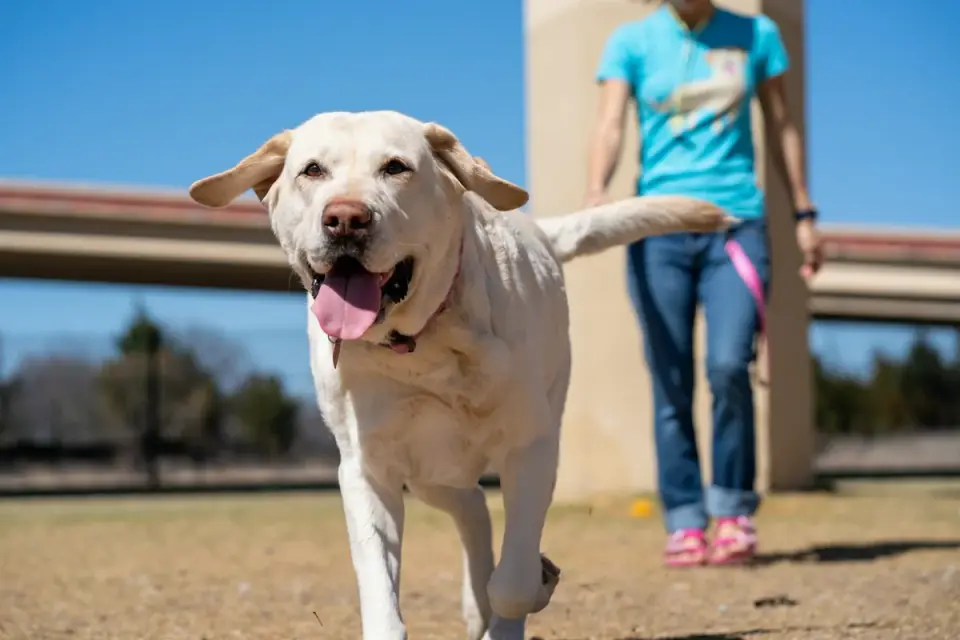
Picture a 12-year-old Labrador who has always slept through the night. Over about six weeks, his owner notices him standing at the bottom of the stairs at 2 a.m., barking at the wall, then wandering into the kitchen and getting stuck behind a chair. He is 78 pounds, still eating well, still greets people at the door. Nothing about him looks sick. That pattern — disorientation plus a slow multi-week onset plus normal appetite — is the profile that points toward cognitive dysfunction rather than an acute medical problem, and it is the profile that earns a conversation about environmental management and, separately, a veterinary workup rather than a home remedy tried first.
Now put a 9-year-old dachshund next to him. She has intervertebral disc changes typical of the breed, and three nights ago she started barking sharply, once or twice, whenever she shifted position in her bed. No pacing, no disorientation, no wandering — just a sharp vocalization tied to movement. That is not a cognitive picture. That is pain until proven otherwise, and it needs an exam, not an enrichment plan. Conflating the two is the single most common mistake I see: owners assume “old dog barking at night” is one problem with one supplement answer, when it is actually a differential diagnosis.
I reason through it the same way every time, unhurried, from the physiology outward rather than from a symptom list inward: what changed, over what timeline, in which system. A dog’s nervous system does not manufacture nighttime barking for no reason; something in sensation, cognition, or comfort shifted, and the job is to find which one before treating any of them.
The senses fail quietly, and darkness exposes it
Hearing loss and vision loss rarely announce themselves. They erode gradually enough that a dog compensates for months before an owner notices anything. Then the sun goes down, the visual cues disappear, the ambient sound drops, and the compensation stops working. A dog who could not quite hear you approaching all afternoon suddenly cannot hear you at all in a dark, silent house — and he barks at the movement he can no longer place. This is worth ruling out with a straightforward at-home check (does he respond to a normal-volume voice from another room, does he track a treat tossed across a dim room) and a formal exam if either seems off, since AAHA: sensory decline and cognitive dysfunction often arrive together and can be difficult to tell apart without one.
Here is the failure mode I want to warn against, because I have watched owners walk into it with good intentions: they try a calming supplement first, see no change after a few nights, and conclude “nothing works,” when in fact the barking was pain-driven the entire time and no calming agent was ever going to touch it. A friend’s 10-year-old terrier mix went through exactly this — three weeks of a melatonin-based calming chew, no improvement, until a veterinary exam found early hip osteoarthritis. Pain control changed the nighttime pattern within about ten days. The supplement was not wrong to try; it was tried before the diagnosis, which is the part I would change.
Where structure/function supplements fit, honestly
Once pain and sensory causes are addressed or ruled out, and if cognitive decline is the working diagnosis, a reasonable next layer is nutritional and antioxidant support aimed at the aging brain’s cellular environment rather than at the symptom directly. Quercetin, for instance, is a flavonoid with antioxidant properties that has been studied for immune and cellular support, though its mechanisms in feeding and behavior are still being worked out in early laboratory models — one in vitro study found that quercetin and related compounds “did not affect the feeding behavior” of the model organism tested at the concentrations used, a reminder that lab findings do not automatically translate into a clinical effect in dogs (source: Pharmaceuticals). Resveratrol carries a similar caveat: it is an antioxidant of real interest in aging research, but dose and exposure timing matter enormously in early studies — one recent paper found that embryonic exposure to a resveratrol-related compound “accelerated pupation and adult emergence but shortened adult lifespan” in its model system (source: Phytomedicine). That is not a reason to dismiss these ingredients; it is a reason to hold them as promising rather than proven, and to keep expectations honest with the client in front of you.
That is the line I try to hold with every senior-dog owner: structure and function language, never a cure, and an open acknowledgment of what the evidence actually supports today versus what it might support once more canine-specific research exists. If your dog’s workup points toward cognitive decline, our companion piece on the supplements that actually help a slowing senior dog walks through that layer in more depth, and if the vocalization is paired with new startle responses during the day, why an old dog startles at sounds he used to ignore is worth reading alongside it, since sensory and cognitive decline frequently overlap.
The edge case that changes the plan
Here is the scenario that trips up even careful owners. A 14-year-old, 62-pound mixed-breed dog had a textbook cognitive-decline pattern — nighttime pacing, disorientation, barking at empty corners — for nearly a year, well managed with a consistent bedtime routine and a dim night-light. Then, over roughly ten days, the barking pattern changed: it became more frequent, higher-pitched, and started happening even during a daytime nap. That shift in character, not just frequency, is the signal to go back to the vet rather than assume “the cognitive decline is just progressing.” A new pattern layered on top of an old one can mean a second problem has arrived — a urinary tract infection, an ear infection, an emerging orthopedic pain source — riding on top of the cognitive baseline you had already adjusted to. Cognitive dysfunction does not make a dog immune to everything else that goes wrong with an aging body; it just makes the new problem harder to spot, because you have already trained yourself to expect nighttime noise.
What I would actually tell you to do
Get the exam first. Bloodwork, a pain assessment, and a hearing and vision check cost you one appointment and rule out or confirm the categories above with more certainty than any amount of home observation. If cognitive dysfunction is the diagnosis, build the environment around it — consistent routines, a dim night-light, predictable bedtime cues — before reaching for a supplement, and treat any nutritional support as a structure/function layer, not a fix. If the pattern changes shape rather than just intensity, that is your signal to recheck, not to assume progression. And if hind-end soreness or new gait changes are part of the picture, our guide to dog hind leg weakness is a useful companion for sorting out whether pain belongs in the differential too.
For a broader look at what belongs in a senior dog’s supplement routine once the medical workup is done, see our evidence-led review of longevity supplements for senior dogs.
Frequently asked questions
Is it normal for an old dog to bark at nothing at night?
It is common, but "nothing" usually means the trigger is internal — pain, sensory loss, or cognitive change — rather than truly absent. It warrants a veterinary exam rather than being written off as normal aging.
How do I tell if my senior dog's night barking is pain or cognitive decline?
Look at the pattern: sharp barks tied to movement or position changes point toward pain, while pacing, disorientation, and getting stuck behind furniture alongside the barking point toward cognitive dysfunction. Onset speed matters too — sudden points to pain or a medical event, gradual points to cognitive change.
Can supplements stop nighttime barking in senior dogs?
Structure/function supplements like quercetin and resveratrol are studied for antioxidant and cellular support, but the evidence in dogs specifically is still early. They are not a substitute for a veterinary workup and should not be the first thing tried.
Sources
- Behavior Counseling — Senior Pet Cognitive Dysfunction — VCA Animal Hospitals
- Managing Cognitive Dysfunction and Behavioral Anxiety — AAHA
- Quercetin feeding behavior study — Pharmaceuticals
- Resveratrol embryonic exposure study — Phytomedicine