Border Collie vs Australian Shepherd: The Real Differences That Matter Long-Term
I've re-homed a dog for exercise mismatch exactly once in my career, and it was a Border Collie whose owners had genuinely wanted an Australian Shepherd's energy, not this dog's.
On this page
Quick criteria checklist — read this first, then the reasoning below:
- Work drive: Border Collie is the more singularly obsessive worker; Australian Shepherd is driven but more willing to clock out.
- Household fit: Aussies generally tolerate family chaos and multiple handlers better; Border Collies often bond hardest to one person.
- Exercise floor: both need real daily output, not a walk around the block. The Border Collie Dog Breed Information: AKC calls Border Collie energy “very high,” and Aussies are commonly built for Official Standard of the Australian Shepherd: 1.5 to 2 hours of daily physical activity.
- Coat and grooming: Aussie coat is heavier and sheds more; Border Collie coat (rough or smooth) is comparatively lower-maintenance.
- Genetic health load: Aussies carry meaningfully higher MDR1 drug-sensitivity risk; both breeds carry real Collie Eye Anomaly risk that needs a DNA or ophthalmologic check before breeding or, honestly, before you fully relax.
- Bite-sized honesty: neither breed is a good fit for a household that wants a dog to be calm by default.
What twelve years of exam-room conversations taught me about this question
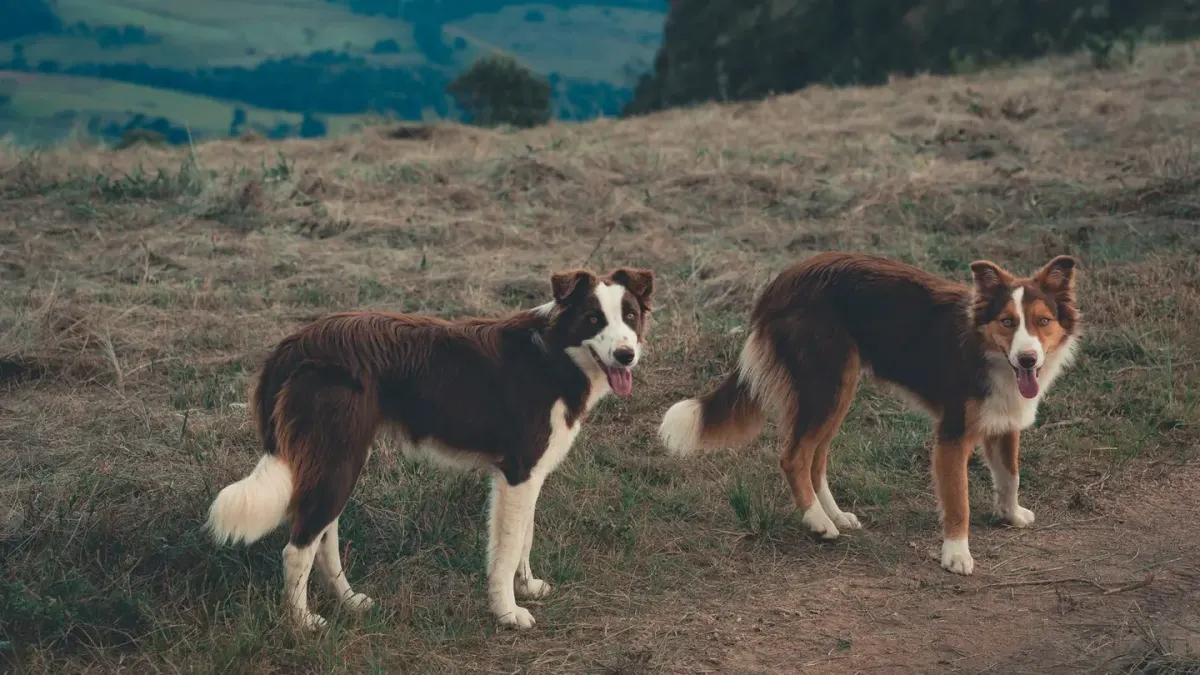
In my practice, the owners who ask me to compare these two breeds have almost always already decided on the coat. I get it — they’re both striking dogs. But the question I actually want them to answer first is who in the house is going to do the two hours a day, every day, for the next decade. I had a family bring in a nine-month-old Border Collie named Fig, a 34-pound female who’d started chewing through a drywall corner in the laundry room by 6 p.m. most weeknights. The owners worked from home but in back-to-back meetings until 5. Fig wasn’t sick. She was a herding dog with no herd, no job, and a body built to run eight miles a day. We didn’t change her food or her meds. We changed her schedule — a 6 a.m. run, a midday flirt-pole session with a dog walker, and a scent-work puzzle at night. The drywall problem stopped within about three weeks. That’s not a Border Collie flaw. That’s what happens when you buy a working brain and give it an apartment.
Temperament: obsessive focus vs. workhorse warmth
The AKC describes the Border Collie as “energetic, intelligent, keen, alert, and responsive,” an “intense worker of great tractability” that may be “sensibly reserved towards strangers.” That reserve is real and it’s not shyness — it’s a dog that’s evaluating you. Border Collies tend to fixate: on a ball, on a sheep, on a shadow moving across the kitchen floor. That single-mindedness is what makes them extraordinary at agility and herding trials, and it’s also what makes an under-stimulated one develop odd, repetitive behaviors — light-chasing, tail-spinning, obsessive fence-running.
Australian Shepherds run a slightly different emotional profile. The breed standard calls for “an even disposition,” “good natured and seldom quarrelsome,” though “somewhat reserved in initial meetings.” In my experience that translates to a dog that’s still intensely driven — Aussies were bred to work long days on ranches — but more socially flexible. They tend to tolerate a rotating cast of family members, kids, and visiting dogs with less friction than a Border Collie typically shows. If your household has multiple handlers, unpredictable schedules, or young kids who’ll be the ones walking the dog some days, that flexibility matters more than people give it credit for.
Neither dog is a couch breed. Both will find their own job if you don’t give them one, and you usually won’t like the job they pick.
Exercise load: the number that actually predicts success or failure
This is where I see the most mismatches. Aussies are commonly cited as needing 1.5 to 2 hours of daily physical activity for good behavior, and that’s a floor, not a ceiling, for a dog from working lines. Border Collie energy is described by the AKC as “very high,” and keeping one “active ensures they remain on their best behavior” — a polite way of saying an under-exercised Border Collie will find behavior you don’t want.
The distinction that actually matters day to day isn’t total minutes, it’s intensity and mental load. A tired-body, bored-brain Border Collie is still a problem dog. Both breeds need physical output plus a job — nose work, herding balls, agility, structured obedience — not just distance covered. If your realistic daily budget is a 20-minute walk, neither breed is the right answer, and I’ll tell owners that directly rather than let them find out at month four.
Health risks worth knowing before you commit
Both breeds descend from herding stock and share several inherited conditions, but the risk profile isn’t identical.
Collie Eye Anomaly (CEA) shows up in both breeds. It’s a congenital condition affecting the retina, choroid, and sometimes sclera, ranging from mild and clinically silent to vision-threatening. A NCBI/PMC: molecular diagnostics study on predisposed breeds confirms Collie Eye Anomaly turns up across Collies, Shelties, Border Collies, and Australian Shepherds, which is why a CEA DNA test or an early ophthalmologic exam is worth doing in either breed, not just one.
MDR1 drug sensitivity is where the two breeds genuinely diverge. Border Collies carry a comparatively low rate of the defective MDR1 gene copy — reporting suggests under 5% — while Australian Shepherds carry it far more commonly, with estimates suggesting roughly half the breed is affected to some degree. That’s not a cosmetic difference: a dog with MDR1 mutation can have a serious adverse reaction to standard doses of certain common medications, including some anti-parasitics and sedatives. If you go the Aussie route, ask your vet about MDR1 testing before your dog ever needs one of those drugs, not after.
Hip dysplasia is a factor in both, more a function of how carefully a given line was screened than an unavoidable breed destiny — Border Collie Dog Breed Health and Care: PetMD’s Border Collie and Australian Shepherd Dog Breed Health and Care: PetMD’s Australian Shepherd breed pages both flag it as a condition to ask breeders about, alongside hip and elbow certifications.
None of this means either breed is fragile. It means you should ask a breeder for OFA hip scores and CEA/MDR1 testing on the parents before you fall for a litter of puppies, the same way you’d ask about any working-line dog.
What I tell owners in the exam room
A woman came in last spring with a 6-year-old Australian Shepherd, Cooper, who’d started struggling on the back steps after his usual off-leash hikes — nothing dramatic, just a slight hitch getting up after resting, noticed first on cold mornings. She’d been comparing supplements and cartilage-support routines with a neighbor who had a Border Collie of similar age with no such issue. I told her what I tell most owners of aging working breeds: joint changes in dogs this active often show up as small behavioral shifts — hesitating before a jump, slower recovery after exertion — well before anything appears dramatic. We started tracking his stair behavior weekly and talked about weight and surface management rather than assuming it was breed-specific. It wasn’t really about which breed he was. It was about matching what we watched for to what his specific joints and years of activity had actually put him through.
If you’re choosing between these two dogs, choose based on how much unstructured chaos your household generates and how many hands are available to meet a working brain’s daily demand — not the coat pattern. Border Collies reward a single dedicated handler with near-telepathic focus. Australian Shepherds reward a busier, less predictable household with more social give. Both will out-work almost any home that isn’t prepared for them, and both deserve genetic health screening before you commit to fifteen years with one.
For readers managing an aging dog of either breed, our guide on evidence-led longevity supplementation covers what’s actually been studied versus what’s still hypothesis. And if joint changes are part of what you’re watching for, our breakdown of hyaluronic acid research is a reasonable next stop.

Frequently asked questions
Which breed is smarter, Border Collie or Australian Shepherd?
Both rank among the most trainable herding breeds, but they express intelligence differently — Border Collies tend toward singular task focus, while Australian Shepherds show more adaptable, socially responsive problem-solving. Neither test scores translate directly to which is "smarter" in daily life.
Do Border Collies or Australian Shepherds shed more?
Australian Shepherds typically carry a heavier double coat and shed more consistently, including seasonal blowouts, compared to the generally lower-maintenance Border Collie coat.
Is MDR1 testing necessary for both breeds?
It's worth doing for either, but especially important for Australian Shepherds, where roughly half the breed population is estimated to carry some degree of the mutation, versus under 5% in Border Collies.
Sources
- Border Collie Dog Breed Information — AKC
- Official Standard of the Australian Shepherd — AKC
- Analysis of Selected Eye Disorders in a Group of Predisposed Breeds of Dogs: Molecular Diagnostics of Collie Eye Anomaly and Progressive Retinal Atrophy — NCBI/PMC
- Border Collie Dog Breed Health and Care — PetMD
- Australian Shepherd Dog Breed Health and Care — PetMD